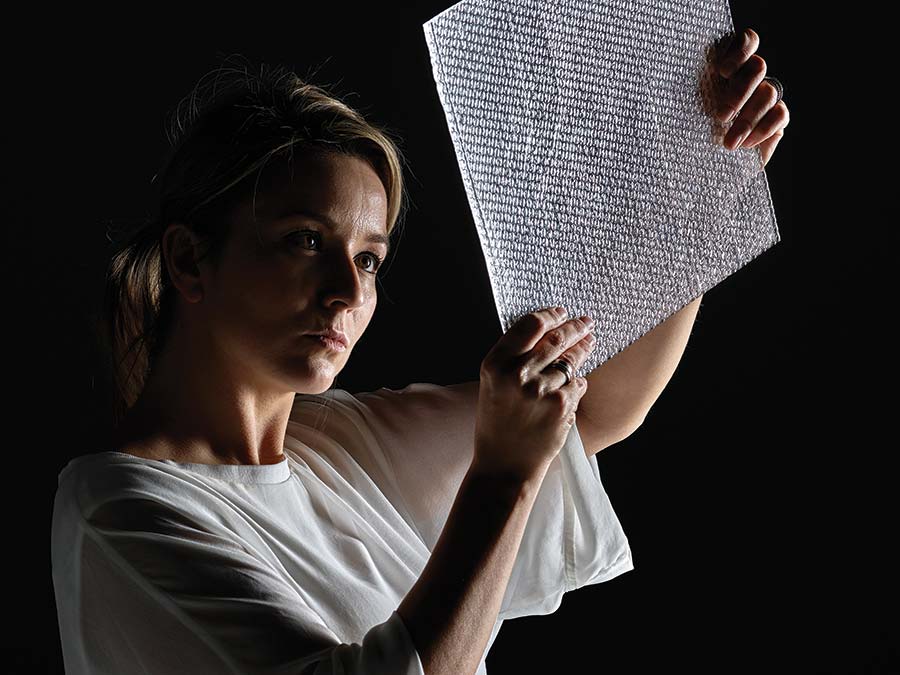
How glass fusing portraits are made
There is a moment, standing in front of one of Isabelle Scheltjens’ glass fusing wall art portraits, when something shifts.
From up close, the surface is a dense and luminous field of colour. Hundreds of glass fragments, each hand-cut, each placed with deliberate intent. Step back ten feet, and a face emerges. A gaze. An expression so precise it could pass for a photograph.
That distance is where Isabelle Scheltjens’glass fusing portraits begins to speak. Understanding how it is made changes the way you see it forever.

The foundation of glass fusing wall art
Glass fusing is a firing technique in which separate pieces of glass are placed together and heated in an oven until they bond into a single, unified surface.
In its traditional applications the technique has been used for architecture features. Isabelle Scheltjens took that foundation and built something the art world had never encountered before. She developed a method of constructing photorealistic glass fusing portraits from thousands of individually hand-cut fragments, arranged according to a visual logic that only reveals its full meaning at distance.
Her technique is not shared, not taught and not replicated anywhere else on earth. It took years of experimentation to arrive at the system she uses today.
The body of work it has produced now hangs in galleries across:
- New York
- Dubai
- London
- Monaco
- Hong Kong
- Paris, and many more
When collectors, architects and institutions encounter her glass fusing art for the first time, the response is almost always the same: they have never seen anything quite like it.


Up to eighty thousand fragments, one face
Each glass fusing portrait is built from thousand and thousand pieces of glass, arranged in layers before being fired in an oven at approximately 800 degrees Celsius.
The fragments vary in colour, size and translucency. The arrangement is guided not by a mechanical grid but by Isabelle’s trained eye and her deep understanding of how the human eye processes colour and form at different distances.
The process begins with a photographic reference and an intensive period of study. Isabelle analyses the light, the shadow, the colour temperature and the emotional quality of the expression.
The result is a surface that carries depth, radiance and a physical presence that printed or painted work simply cannot achieve. Light passes through the glass and reflects off it, changing with the time of day.
A glass fusing portrait created by Isabelle Scheltjens looks different in morning light than it does under an evening lamp. That living quality is why collectors, interior designers and institutions choose her work for the most important spaces in their buildings.

The pointillist principle, reimagined in glass
The visual logic behind Isabelle’s glass fusing art draws a direct line to the pointillist tradition pioneered by Georges Seurat in the 1880s.
Seurat understood that the eye blends separate colour points into unified form when viewed from sufficient distance. Where he applied paint in small dots, Isabelle applies glass in fragments. Where he worked with pigment on canvas, she works with fired material that carries light from within. The parallel is not superficial. Both practices demand a complete mental separation between the unit of construction and the final image.
The glass fusing artist must hold the finished portrait in mind while placing each fragment, never losing sight of the whole while executing each detail. That discipline places Isabelle Scheltjens among a very small number of contemporary artists who have genuinely expanded what a portrait can be.
Why glass is unlike any other material in wall art
The choice of material in art is never neutral. Glass behaves in ways that no synthetic or painted surface can replicate.
It transmits light, refracts it and holds colour across decades without fading. A glass fusing portrait develops a presence in a room that changes depending on where you stand and what time of day it is. It is not a static object. It is a living surface that responds to its environment.
Portraits that art made from synthetic materials, resins, cast compounds or industrial plastics operates on an entirely different visual principle. The surface reflects light rather than engaging with it. The colour is applied rather than embedded in the material itself.
Unlike glass, which matures with light and time, synthetic surfaces age in ways that diminish rather than deepen the work. For collectors and institutions buying with a long-term perspective, the material difference is not a minor technical detail.
It is the defining factor in whether a work holds its value, its presence and its meaning over decades.
Isabelle Scheltjens was the first artist to apply the glass fusing technique to large-scale photorealistic portraiture in the way she does. That pioneering position is documented across galleries on four continents, in internationally recognised private collections, and in a decade of exhibition history that no other artist in this specific discipline can match.

From a single experiment to international collections
The technique began in her husband Dirk Neefs’ studio with a portrait of her daughter, an experiment that surprised everyone, including Isabelle herself. The response was immediate enough to convince her to continue. The decade that followed was one of sustained refinement, international exhibition and growing recognition from collectors who understood that what she was doing had no precedent.
Today her works are held in the private collections of Kevin De Bruyne, Gordon Ramsay and Lotus Bakeries, for example.
Her glass fusing wall art has been presented by leading galleries in New York, Paris, London, Monaco, Dubai, Hong Kong and South Africa. Her studio in Belgium is where it continues to evolve.

About Isabelle Scheltjens
Isabelle Scheltjens is a Belgian contemporary artist and the world’s only practitioner of photorealistic glass fusing portraiture at this scale. Her work spans glass fusing wall art, marble sculptures and bronze sculptures. Each discipline rooted in the same obsession with faces, light and perception. Works are available for private purchase, corporate acquisition and art rental. Isabelle accepts a limited number of bespoke commissions each year for collectors and interior design projects worldwide.